
See auxi in action
your workflows and save you time!
You pass on an RFP because the principal and associates who would develop the proposal are staffed on a live case. Six months later, the case team can use AI to assemble the proposal with less effort. The relationship partner wants to revisit the opportunity.
Reconsidering it makes sense. The pursuit costs have changed. Your relationship with the buyer, your chance of winning and the availability of the delivery team may remain the same.
For AI-assisted bid/no-bid decisions, we recommend that firms evaluate expected contribution after pursuit costs, then check the constraints on senior attention and delivery capacity. At auxi, we want teams to have more choice about the work they pursue. That includes the choice to decline a bid they could produce.
Recalculate the marginal pursuit
A 2026 survey of proposal teams reported average annual submissions of 166, up from 153 the year before, and identified bandwidth as the leading challenge. These survey findings describe rising volume and pressure; they do not establish that AI caused either.
A partner deciding whether to add another pursuit needs a smaller unit of analysis: the next RFP, and the work the team would forgo to respond.
Use a first-pass calculation:
Expected pursuit contribution = probability of winning × contribution if won − pursuit cost.
Define contribution with finance. Deduct the relevant delivery costs from expected revenue, and avoid counting the same labor again under pursuit costs. The result remains an estimate. It helps the team expose assumptions before committing time.
Compare opportunities that compete for the same people
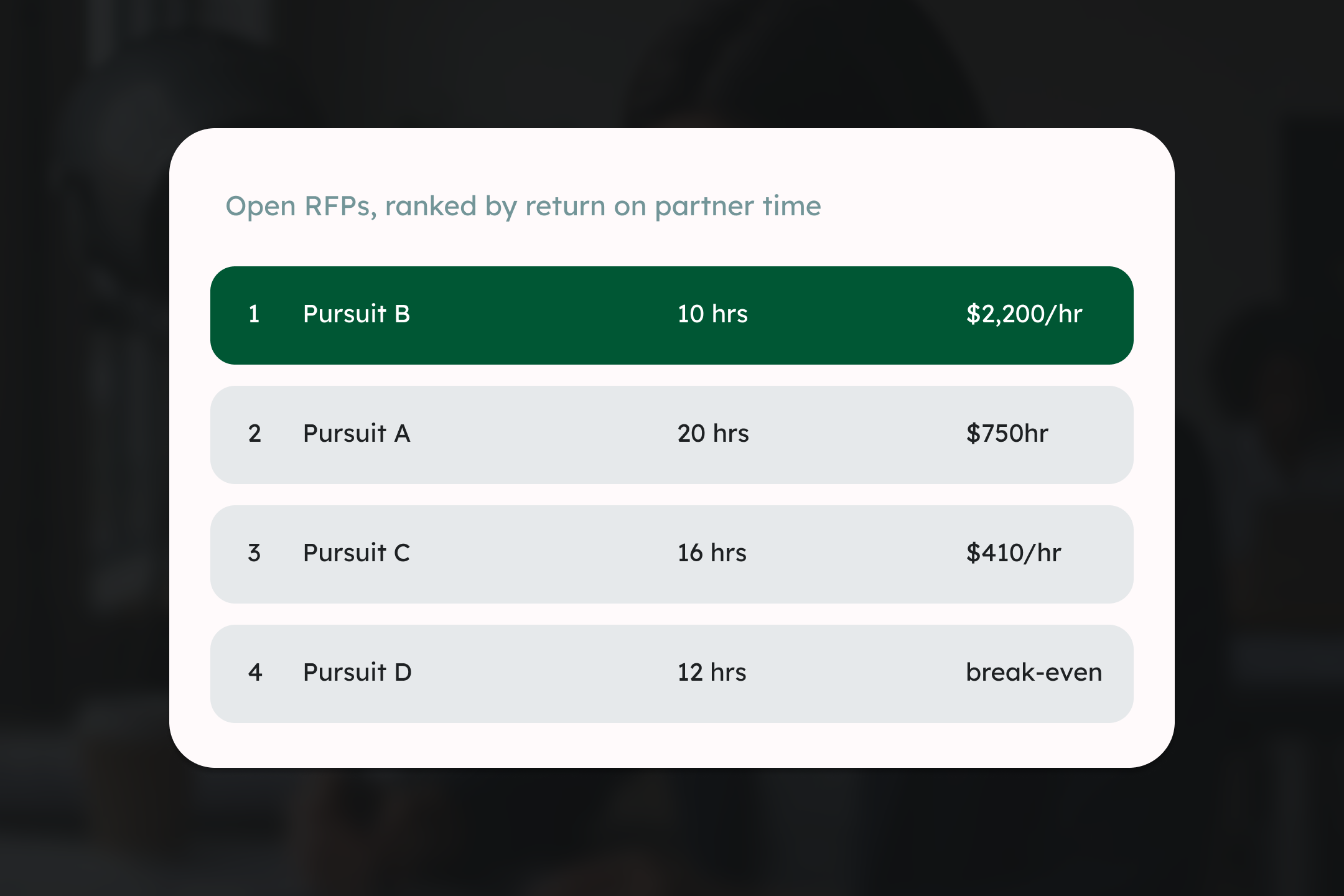
Consider two fictional pursuits after the case team adopts AI. Pursuit A would contribute $100,000 if won, with an estimated 20% win probability and $5,000 of pursuit cost. The partner therefore estimates $15,000 of expected contribution after pursuit cost. Preparing the proposal and leading the client discussions would require twenty partner hours.
Pursuit B would contribute $60,000 if won. With a 50% estimated win probability and $8,000 of pursuit cost, the partner estimates $22,000 of expected contribution. It would require ten partner hours. Both contribution estimates include the relevant case delivery costs, and both pursuit estimates include the internal cost of preparation and review.
The larger potential win attracts attention to A. A partner who has ten hours available this week has a stronger expected return from B under these assumptions. For comparison, the estimates amount to $750 per partner hour for A and $2,200 for B.
Use that ratio to compare the constraint; avoid deducting partner labor twice. It also cannot replace a portfolio decision. If both bids require a sector expert who is committed to another engagement next quarter, the staffing lead and relationship partner must resolve that constraint before treating either expected return as attainable.
AI could lower A's pursuit cost again and change the ranking. A stronger relationship with its buyer could have a larger effect by increasing the win estimate. Make both assumptions visible instead of attributing the whole business case to drafting speed.
Check the consequences of winning several bids together. If the same specialist must lead both projects during the same month, adding their expected contributions overstates what the team can deliver without a staffing change. Review the portfolio against that possibility, even if neither win appears certain on its own.
Challenge the probability before refining the arithmetic
A partner can make a weak pursuit look attractive by entering an optimistic win probability. Ask for the basis: prior work with the buyer, access to the decision-maker, relevant credentials and the competitive situation.
Review prior bids in comparable groups. An incumbent renewal differs from a cold invitation to a crowded tender. A single firm-wide win rate conceals that distinction.
For the example above, A breaks even on expected contribution at a 5% win probability: $5,000 divided by $100,000. That low threshold might justify a bid if the team had ample capacity. With limited partner time, it must also compare A with the available alternatives. Passing a break-even test does not settle which pursuit deserves the week.
Historical records have another limit. You observe outcomes for bids you pursued and little about those you declined. Treat a precise prediction for an unfamiliar opportunity with care, even if an AI tool produces it with confidence.
Give strategic pursuits an explicit partner commitment
A practice may accept a low expected return to enter a market or establish a relationship. Record that intent. Name the partner who owns the investment and set a limit on the pursuit effort.
At the review, assess whether the team gained the access or learning it sought. If partners label a pursuit strategic after losing it, they cannot learn much from their bid history.
Reserve capacity for these choices in the portfolio. Otherwise, a spreadsheet that ranks near-term contribution may keep the practice in its existing markets, even when leadership has agreed to expand.
Evaluate the extra bids after adoption
Track the opportunities the team would have declined before using AI. Compare their pursuit effort and outcomes with the rest of the portfolio, allowing for differences in client relationship and scope. Include time spent by specialists who helped without recording it against the bid.
Your team may discover that cheaper production made a new segment viable. It may find that the additional responses absorbed scarce review hours with little return. Either result gives the practice a basis for adjusting its qualification rules. At auxi, we would rather help a team make that decision with evidence than ask it to treat a higher submission count as sufficient proof of success.