
See auxi in action
your workflows and save you time!
An associate brings you the first cut of a workstream deck. You ask why the team chose a particular customer segment. The consultant repeats the argument on the slide. You change an assumption and ask whether the recommendation holds. The consultant needs to return to the AI assistant.
As an engagement manager, you need to distinguish a good deliverable from the author's ability to reason through a new problem. You care about both. Your next engagement will present conditions the current draft does not cover.
At auxi, we believe firms can remove repetitive presentation work while preserving analytical practice. Training junior consultants with AI requires engagement managers and principals to specify the judgment they want people to develop, then give them opportunities to exercise it and receive feedback.
Decide which part of the assignment teaches the skill
Building a slide can involve several kinds of effort. An analyst may choose a comparison, examine the source data and decide which caveat changes the conclusion. The analyst may also spend time adjusting spacing and moving objects into alignment.
The learning value differs. An engagement manager who wants to teach evidence assessment should ask the analyst to explain the source and its limits. Requiring the analyst to spend longer formatting the chart gives the engagement manager little assurance about that skill.
Name the capability before deciding how much AI assistance to allow. For a market-sizing task, you might want the junior to distinguish a population estimate from a reachable customer base. For a pricing analysis, you might want the junior to identify the assumption with the greatest effect on margin. Those aims call for different exercises.
Examine the evidence without assuming decline
A June 2026 survey of 70 executives found that half reported observing declining skills in their organizations. The respondents described their perceptions; the researchers did not establish a causal decline in junior consultants' abilities. Principals and engagement managers can use the findings to motivate assessment without treating AI use as evidence that a colleague has lost competence.
A capable junior can also learn from AI: asking for competing explanations, examining examples and testing a calculation. The engagement manager needs to evaluate what the person can do after that work. Time spent without AI is a poor measure of learning on its own.
Try a different sequence on a low-risk assignment
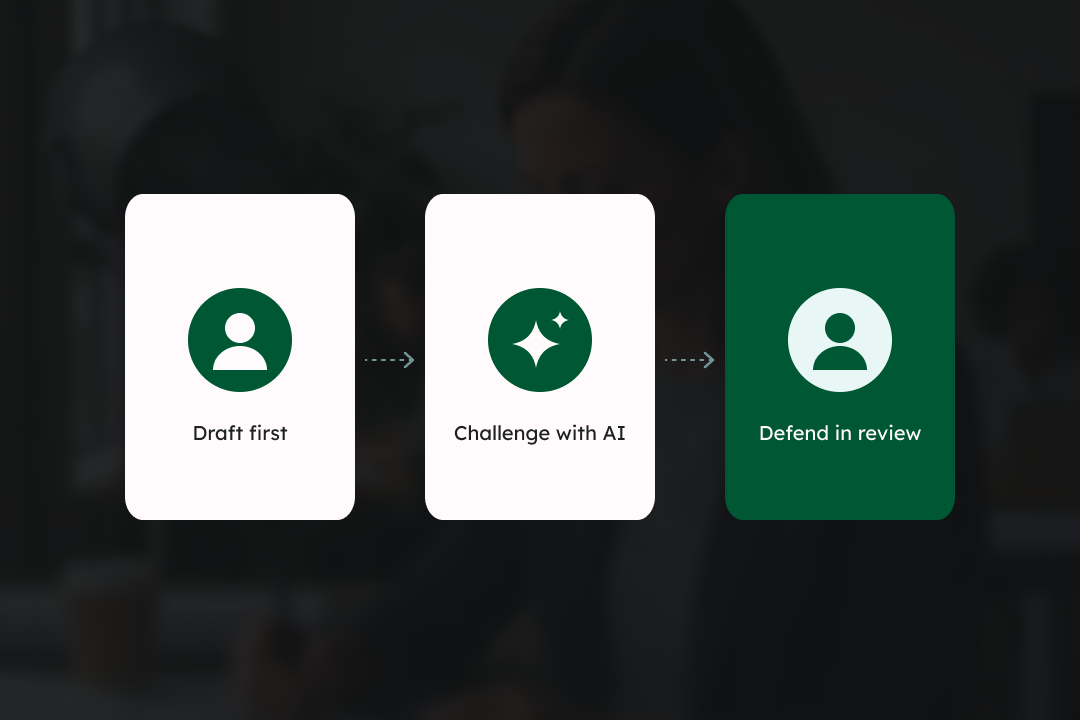
For a training case, ask the junior to write a short initial recommendation before using AI. Require an explanation of the key assumption and the evidence they need to check. Keep this stage brief enough that the team can use it within the workday.
Next, ask the junior to use the approved tools to challenge the recommendation. They can request an alternative interpretation or look for evidence that contradicts the initial view. The junior should record which challenge changed the analysis and why.
During the review, ask the junior to defend the final recommendation without consulting the assistant. Introduce a change to an assumption. The goal is to examine the reasoning, including the person's ability to recognize when they lack enough information to answer.
This is a proposed training practice. We are not claiming that auxi has run a study proving it improves skill retention. An engagement manager can assess its usefulness on new assignments and change the exercise based on what the team learns.
Use the ghost deck as a coaching tool. Ask the associate to draft the proposed page titles and the exhibits needed to support each claim before building the pages. During the problem-solving session, the engagement manager can challenge the storyline while the cost of changing it remains low. AI can help produce the exhibits after the team agrees on the analytical purpose of each page.
Give feedback on the inference
“Think harder” leaves a junior with little direction. Identify the step that needs work.
Suppose the junior recommends entering a customer segment because it has high average spending. Ask whether the client's offer addresses the source of that spending and whether the sales team can reach those customers at an acceptable cost. Help the junior locate the unsupported step between the statistic and the recommendation.
An AI assistant may suggest those objections too. Your contribution as an engagement manager includes deciding which objections matter in this client's circumstances and explaining that judgment. The junior needs to hear the reason, including how you weigh incomplete evidence.
Review your own use of AI under the same standard. A senior person who forwards a generated analysis without checking it gives juniors a poor example of the behavior the firm expects.
Assess transfer on a new case
A junior can memorize the explanation of the current assignment. Use a later task with different details to examine whether the person can apply the reasoning.
Assess the ability to frame the decision and test an assumption. Record how much help the junior needed and compare with their prior work. Keep the evaluation separate from surface presentation quality. A rough explanation may reveal sound reasoning; a polished deck may conceal a gap.
Include coaching time in the cost of the approach. Firms that remove junior work without funding another way to develop judgment may discover a gap in preparation as those employees take responsibility for leading engagements.
For an auxi-enabled team, we would encourage engagement managers to reserve some recovered production time for that coaching. Let juniors use tools for the tasks the firm wants to accelerate. Give them explicit responsibility for the analytical choices they need to learn, and review those choices with them before the next assignment raises the stakes.