
See auxi in action
your workflows and save you time!
A business analyst finishes the first cut of the steering committee deck in two hours instead of eight. The partner spends the afternoon checking its sources and reconstructing a calculation. At the end of the week, the analyst reports six hours saved. The partner reports another late evening.
You need both accounts to evaluate AI productivity. For a professional deliverable, calculate the team's effort through acceptance, with the cost of each person's time. Include the extra review or correction associated with the AI-assisted approach. We use “AI review tax” as shorthand for that incremental work, not as a claim that using AI must increase review.
At auxi, we think buyers should measure this during a pilot. A tool can create value by reducing author effort, reviewer effort or both. A first-draft timing captures part of that result.
Compare labor cost across roles
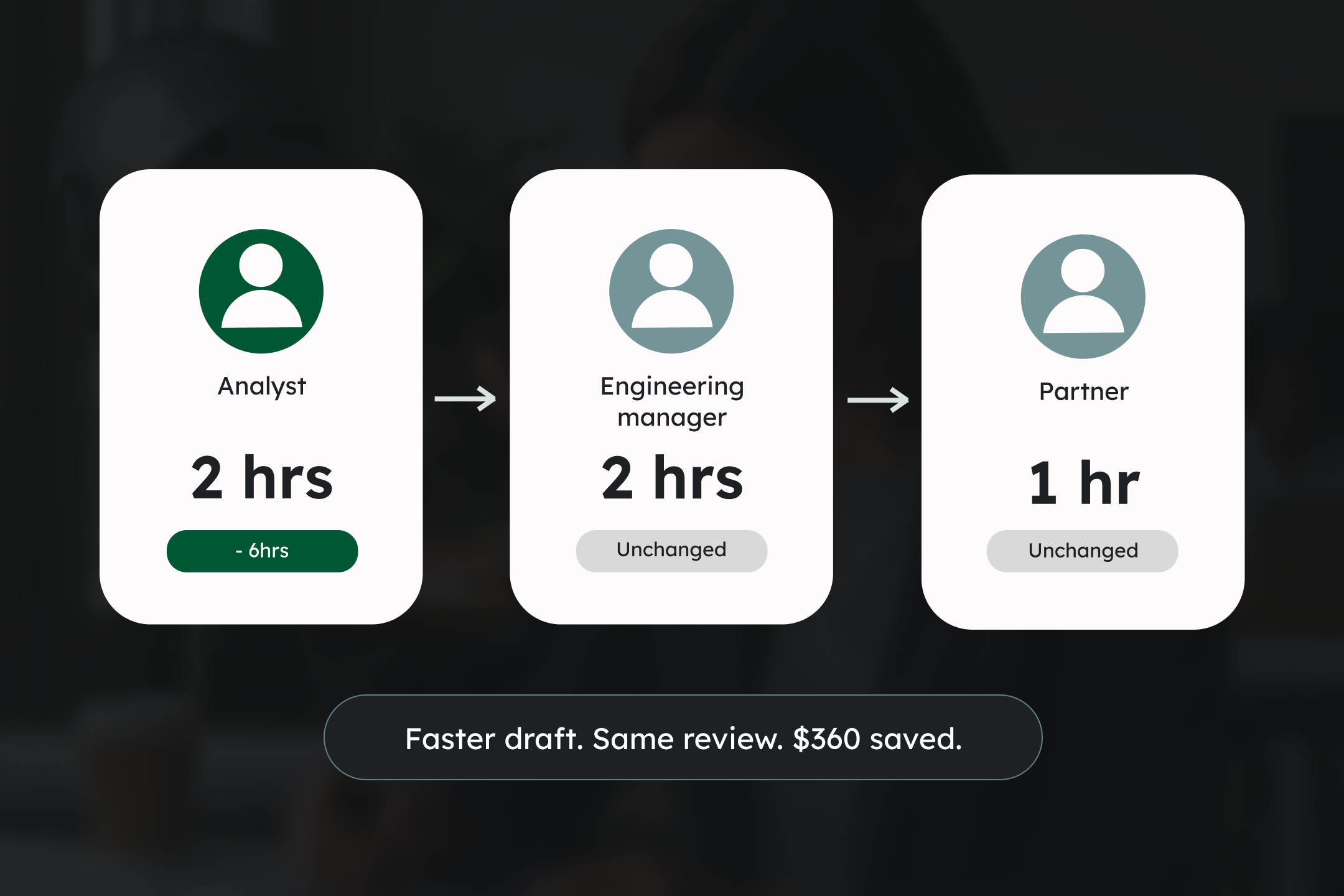
Consider an illustrative case-team deliverable. In the conventional workflow, a business analyst spends eight hours on the analysis and pages, the engagement manager spends two hours reviewing them, and the partner spends one hour on the final storyline. At illustrative internal hourly costs of $60, $120 and $250, the team allocates $970 of labor to the deliverable.
In the AI-assisted version, the analyst needs two hours. The engagement manager spends three hours tracing the analysis, and the partner spends three hours resolving inconsistencies in the recommendation. The team uses eight hours in total, compared with eleven before, but allocates $1,230 of labor. These rates are assumptions for the example, not consulting salary benchmarks or billing rates.
The team saves three hours across the deliverable, but allocates $260 more labor cost because senior reviewers spend longer on it. Software and implementation costs would add to the comparison.
Change the review result and the calculation changes. If the engagement manager and partner keep their original review times, the AI-assisted version costs $610 in allocated labor. The firm has a $360 capacity-cost improvement before tool costs. Whether it realizes a financial benefit depends on how it uses that capacity.
A buyer should compare these possibilities using observed work. Neither a vendor's drafting demonstration nor a skeptical account of one bad output establishes the result for the buyer's workflow.
Identify the reason for the review
Reviewers spend time on different problems. An engagement manager may correct a factual error, challenge the argument, or ask for a preferred chart style. A partner may introduce a new client request after the author finishes the draft.
Record those reasons in the pilot. Attribute an unsupported claim or broken calculation to the workflow that produced it. Treat a new scope request as additional work. Include preference changes in the total effort while retaining their separate label; a tool may help the team accommodate them even if it did not cause them.
A September 2025 survey asked 1,150 US desk workers about low-value AI output and the burden it placed on colleagues. The researchers reported that 40% had received such work during the preceding month. Participants supplied those accounts, so the study does not give a measured review penalty for consultants.
Review burden can also flow from senior staff to juniors. A partner who generates a plausible analysis without checking its assumptions may ask an analyst to spend hours establishing whether the recommendation holds. Include those hours even if the partner initiated the task outside the case team's usual process.
In banking, use the review chain your deal team follows. An analyst prepares the pages, an associate checks the model outputs and a VP reviews the valuation narrative before the managing director takes the pitch to the client. If the associate has to rebuild the bridge from enterprise value to equity value to trust the page, count that work against the same deliverable. Keep the banking calculation separate from the consulting example because the staffing and review responsibilities differ.
Give reviewers a way to check the work
Ask authors to retain the supporting sources and the assumptions they used. A reviewer examining a market estimate should be able to locate the source population, conversion and period. Recreating that chain from prose takes time even when the answer is correct.
State the reviewer's job before the handoff. One reviewer may own the analysis, while another checks the client commitments. Sending a deck to several people with a request for an undirected page turn invites overlapping edits and contradictory directions.
AI can help with checks that have a defined standard. The team must still determine who accepts responsibility for the recommendation. A second model's agreement does not establish that the source is accurate or that the client can execute the proposed approach.
Measure approval delay alongside active work
A partner with a full calendar may need two days to find an hour for review. Keep those two days separate from the labor calculation. Record elapsed time because the client deadline depends on it, and active time because the firm must allocate people to it.
Reducing the partner's review demand may help the team meet a deadline even if the author works the same hours. A faster draft may wait in the same review queue. Engagement managers need that distinction to decide whether to change the tool, the assignment or the approval process.
For an auxi pilot, choose work that resembles the team's normal assignments and agree on the acceptance standard before comparing approaches. Follow each deliverable through review. Ask the partner and the analyst to record their effort against the same job. You can then discuss the result in the terms both people recognize.