
See auxi in action
your workflows and save you time!
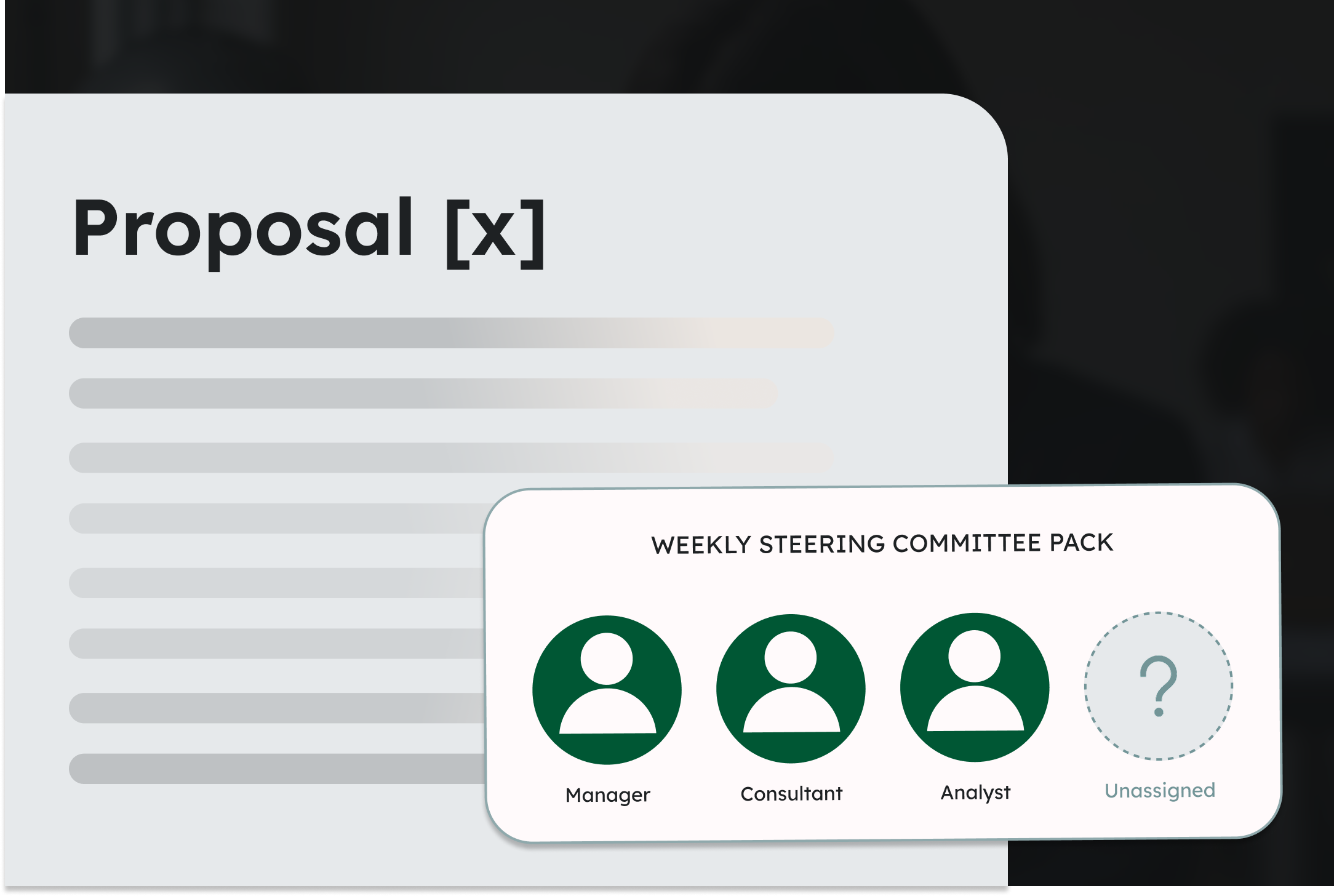
The partner promises weekly steering committee support in the proposal. At kickoff, the engagement manager discovers that the client expects a refreshed dashboard, a regional performance breakdown and a new executive storyline each Friday. The associates who developed the proposal assumed a short progress update.
The case team now has a recurring deliverable that nobody included in the staffing estimate. The engagement manager can absorb the work, reduce effort elsewhere or ask the partner to reopen the scope with the client sponsor.
At auxi, we think consulting teams should use some of the time they recover in proposal production to examine that gap. A credible commercial proposal connects the promised workstreams to the staffing pyramid and the client's obligations. The engagement manager needs those connections before accepting responsibility for the case.
Carry the commercial assumptions into the workplan
On an RFP-led pursuit, a principal or associate preparing the response may use a compliance matrix to ensure the team has addressed the client's requirements. That helps prevent omissions. The prospective engagement manager needs to understand how the partner expects the case team to fulfill each material commitment.
Consider a promise to provide local expertise. The partner might mean a named sector specialist joining two problem-solving sessions. The client might expect a consultant on the ground throughout the engagement. Both could read the same sentence and think they agree.
State the resourcing assumption beside the proposed work. Identify the accountable partner, the engagement manager and the specialist support the case will require. Distinguish committed availability from a staffing request the practice has yet to resolve.
For steering committee support, specify the expected cadence and the work behind the pages. The associates may need to reconcile workstream inputs, update the fact base and develop the storyline before the engagement manager can review it. Writing the promise as a single deliverable does not make that preparation disappear.
Cost the recurring work before agreeing the fee
Take a fictional twelve-week engagement. Assume the weekly steering committee pack requires six business analyst hours and one engagement manager hour. At illustrative internal costs of $60 and $120 an hour, the practice would allocate $480 per week, or $5,760 across the case. These are assumptions for the example, not compensation benchmarks.
The engagement manager must reserve 84 hours of case-team capacity. If the client expects country-level reconciliation before the pack, the effort could exceed that estimate. The principal should resolve the input assumption while negotiating the proposal, when the partner can still adjust scope or fee.
Internal labor allocation differs from cash expenditure on a salaried team. It still affects the case economics. A consultant who spends Friday rebuilding the steering committee pack cannot use those same hours to complete the commercial analysis the partner promised for Monday.
The partner should review the fee alongside the staffing pyramid, the specialist requirements and the recurring outputs. A proposal can look attractive at the headline fee and become much less attractive once the engagement manager includes the support required to deliver it.
Review changes in wording as changes in commitment
An associate asks AI to strengthen a methodology section. The next draft replaces scheduled support with dedicated support and expands an example from one region to several. The principal accepts the wording because it sounds more responsive to the RFP.
Before submission, the prospective engagement manager should examine those changes with the principal. Check whether the team has added availability, geographic coverage or a new output. A stronger claim deserves a staffing assumption and a partner decision.
Reusing a successful proposal can create the same problem. A previous team may have had a sector expert available throughout the case, while the next team can secure two days of that person's time. Confirm the resourcing behind the credentials and methodology rather than carrying the original commitment into the next offer.
Make the client dependencies specific
The client sponsor has to allocate resources too. A request for client cooperation gives the sponsor little to act on.
Explain that regional finance leads must provide reconciled data by Wednesday for the Friday steering committee. Name the client decision-maker who will resolve a disagreement between workstreams. If the proposed timeline assumes access to customers for interviews, state who will arrange that access and when the case team needs it.
Some discovery work will remain uncertain. Agree on a scope review after the initial diagnostic so the partner and sponsor can decide how to proceed with the evidence available. Avoid writing a fixed commitment around an assumption the case team has no way to validate before kickoff.
Bring the relationship partner into the handover
The engagement manager needs the proposal the client accepted, the clarification emails and the assumptions behind the negotiated fee. Review the commitments the relationship partner made during the final client discussion, including concessions that never reached the main deck.
The proposal team and the staffed case team may overlap. Even then, a handover helps the engagement manager translate the commercial offer into workstream ownership and review dates.
We build proposal tools at auxi because consultants spend valuable hours assembling responses. Before sending the next offer, use some of that time to bring the principal, partner and prospective engagement manager together. Resolve the promises that affect the workplan while the team still has room to change them.