
See auxi in action
your workflows and save you time!
You send a proposal to a client who has twenty minutes before the evaluation meeting. The deck includes your approach and price, several credentials, a description of your methodology and an appendix. You know where to find the answer to the client's main concern. The client has to work that out.
At auxi, we help professionals produce presentations. We also have a reason to care about the person receiving them. A team can reduce its production time while asking the buyer to spend longer interpreting the result.
Choose consulting proposal length around the evaluation requirements and the decisions the buyer must make. Give the reader a concise route through the recommendation, with access to the evidence needed to examine it. A universal slide limit cannot account for those differences.
Listen to the buyer and the procurement team
In a recent r/consulting discussion, a self-described buyer asked why proposals contain so many slides. The buyer wanted the approach, price and relevant experience. A respondent described detailed RFP questions that required a much longer response to avoid disqualification. These are unverified accounts, but the disagreement gives the relationship partner and proposal team a useful problem to examine.
Your client sponsor and the procurement lead may evaluate different parts of the offer. The sponsor wants to know whether you understand the problem. Procurement needs a comparable response against stated requirements. A technical evaluator may need to examine assumptions the sponsor will not read.
Before writing, identify those readers and ask how they will assess the response. Follow the requested format. Within that format, help each person locate the material relevant to their decision. A short proposal that forces procurement to hunt for compliance evidence creates work for the buyer too.
A steering committee discussion has the same constraint. The engagement manager may need a detailed fact base in the appendix, while the partner presents an answer-first storyline around two decisions for the client sponsor. Keep the evidence available without turning the meeting into a page-by-page walkthrough of the team's effort.
Estimate the effort on both sides
Consider a fictional comparison. With an AI-assisted workflow, a team produces a forty-slide proposal in four hours. Six evaluators each spend thirty minutes reading it. Combined author and reader time totals seven hours.
The team could spend an additional hour editing and organizing the same offer, allowing each evaluator to complete the review in fifteen minutes. Combined effort would fall to six and a half hours. The authors would report lower production productivity, while the participants would use less time in total.
Those numbers are illustrative. They make the measurement choice visible. The team must also check whether evaluators understand the proposal with the same accuracy. Faster reading at the expense of a missed exclusion would be a poor trade.
Reader effort also differs from reading time. An evaluator who must infer the staffing plan from several pages bears a different burden from one who can inspect a clear description of the staffing plan. Your team can reduce that burden without deleting necessary information.
Lead with the recommendation and the decision required
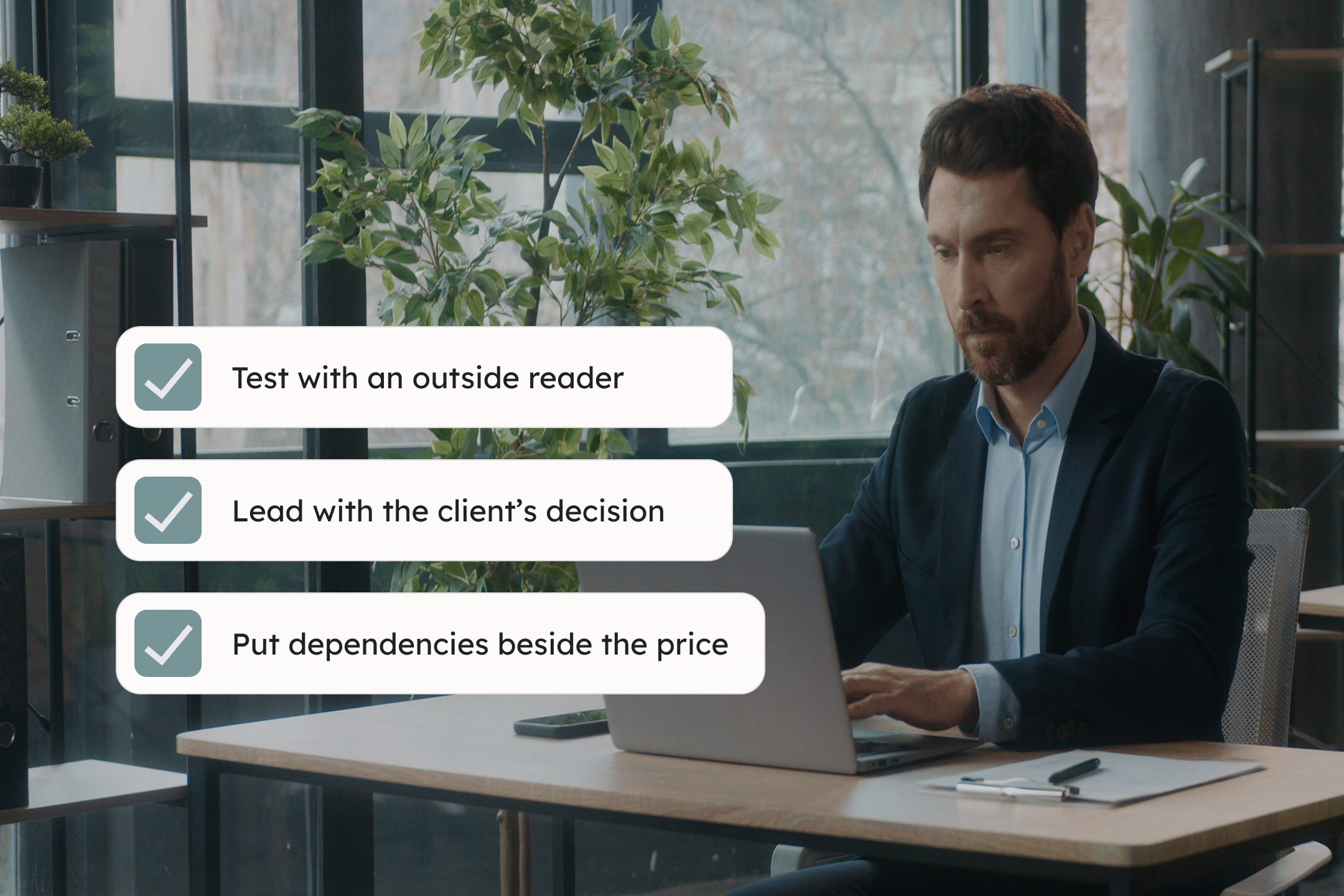
Open with the client's decision and the terms of your recommendation. State the proposed scope and the choice you want the reader to make. Place a material dependency beside the recommendation it affects.
For a fictional market-entry proposal, the opening might recommend entering two cities through a distributor, with an initial validation phase before a national launch. The buyer can then examine the evidence for that choice. Starting with fifteen pages about your firm's capabilities delays the assessment the sponsor came to make.
Give technical reviewers direct access to assumptions and supporting analysis. Use descriptive section titles and references to the relevant appendix material. A navigable appendix lets the team preserve detail while keeping the main discussion focused.
Avoid hiding an unfavorable condition at the back. If the fee depends on client staff doing part of the work, put that dependency beside the price. You should aim for an informed decision, including the possibility that the buyer rejects the offer.
Test the storyline with someone outside the case team
Ask a principal who has not worked on the pursuit to read the proposal within the expected review time. Then ask them to explain the offer in their own words. They should be able to state the recommendation and identify the main commitment the client must make.
Give the reviewer a concrete comparison task: find the price, identify an exclusion, or explain why the team recommends one approach over another. Record the passages they revisit and the questions they cannot answer. Edit those sections before spending another hour polishing a transition slide.
For a larger evaluation, compare two versions with different readers and keep the information constant. Reusing the same reader can make the second version seem easier because the person learned the content during the first reading. A small exercise can guide editing; it cannot establish a universal optimum for slide count.
We believe a presentation team should include reader effort in its definition of quality. During your next auxi evaluation, leave time for that edit. Use some of the production hours you recover to make the recommendation easier to inspect, challenge and approve.