

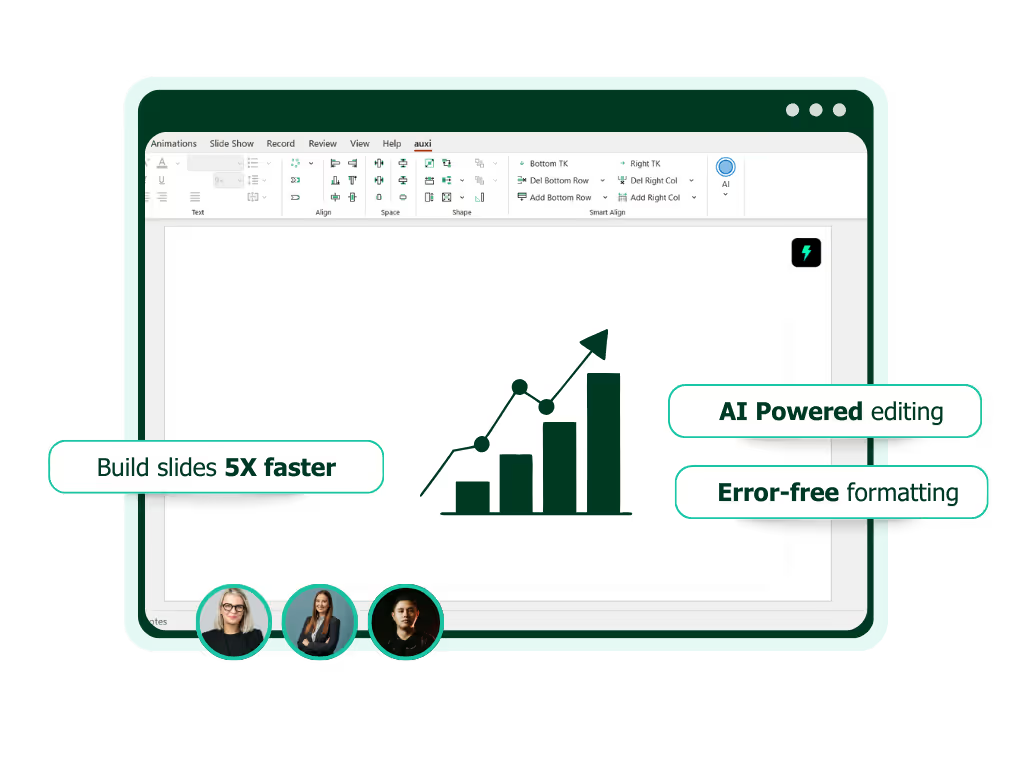
See auxi in action
your workflows and save you time!
Quick Summary
AI transforms investment banking pitchbook creation by automating the most time-consuming and repetitive tasks within PowerPoint. Instead of replacing bankers, AI tools like auxi enhance productivity by generating fully formatted, brand-compliant slides directly inside PowerPoint and eliminate hours of manual formatting, table rebuilding, and content structuring. This allows bankers to focus on strategic analysis and storytelling, accelerating pitchbook delivery without sacrificing quality.
-------------------------
There's a version of investment banking that most people outside the industry don't see. It's not the closing dinners or the tombstone announcements. It's 1:30 a.m. on a Tuesday, and a second-year associate is manually reformatting a 60-slide PowerPoint because the MD wants the font size changed on every title slide. The comps table needs to be rebuilt. The cover page doesn't match the client's branding or colors. And the deal timeline, which took three hours to construct - just got moved up two weeks.
This is the reality that AI in investment banking is beginning to change.
Not by replacing bankers. Not by automating judgment. But by eliminating the hours of repetitive, formatting-heavy, data-intensive PowerPoint work that consumes some of the most talented professionals in finance and keeps them from doing the work that actually moves deals forward.
This guide is for VPs, Directors, MDs, and operations leaders who are thinking seriously about where AI fits into their investment banking workflows. We'll walk through how AI is being used across the full pitchbook and deal prep lifecycle — from initial industry research to final formatting - and what it actually means for the speed, quality, and scalability of your deal work.
Why Investment Banking Has a PowerPoint Problem
Investment banking has always been a high-output, high-pressure environment. Deadlines are real. Client expectations are non-negotiable. And the stakes on any given deck - whether it’s a sell-side M&A pitch, a capital raise, or a fairness opinion - are enormous.
But here’s what often gets glossed over in conversations about productivity in IB: almost all of it lives in PowerPoint.
Not in a project management tool. Not in a collaboration platform. In PowerPoint. Pitchbooks, IB Proposals CIMs, management presentations, board decks, lender presentations, every major client-facing deliverable in investment banking is built, revised, and delivered as a PowerPoint file. It is the universal language of IB deal work, and it has been for decades.
And yet, for all the sophistication of the deals being structured, a significant portion of a banker’s time is spent on PowerPoint work that doesn’t require a finance degree. Reformatting slides. Rebuilding tables. Updating page numbers. Re-aligning text boxes that drifted after a template change. Making sure the font on slide 47 matches the font on slide 3.
People tend to underestimate just how critical PowerPoint skills are in investment banking - junior bankers often spend more time in PowerPoint, making proficiency in presentation creation essential for success.
This isn’t a people problem. It’s a PowerPoint problem. And it’s one that investment banking has been slow to solve. Partly because of the culture (“everyone goes through it”), partly because of legitimate concerns around data security and accuracy, and partly because the tools available until recently weren’t purpose-built for this environment.
Generic AI tools like ChatGPT can draft text and summarize information. But they don’t live inside PowerPoint. They don’t understand slide layouts, master templates, or brand compliance. They produce content you then have to format which means the most painful part of the pitchbook process remains entirely manual.
What investment banking needs is AI that works where bankers actually work: inside PowerPoint, from the first slide to the last.
Building Pitchbooks Faster Without Sacrificing Quality
The pitchbook is the centerpiece of almost every IB engagement. It tells the story of a deal, a company, or a market opportunity. It has to be rigorous, visually compelling, brand-compliant, and increasingly, delivered faster than ever.
The problem is that building a pitchbook in PowerPoint has always been a two-part job. First, you think. Then, you format. And the formatting part consistently takes longer than it should.
AI for pitchbook creation changes this by collapsing the gap between thinking and output. With the right tool, bankers can generate a full deck structure directly in PowerPoint in minutes — not hours. Slide layouts, section frameworks, table of contents, and narrative flow can be scaffolded automatically inside the actual file, leaving the team to focus on what they actually need to think about: the deal thesis, the client positioning, and the quality of the analysis. The answer to faster, higher-quality pitchbook creation is leveraging AI tools that work natively inside PowerPoint, ensuring that the process is both efficient and seamless.
This is a fundamentally different proposition from AI tools that generate content outside of PowerPoint and ask you to paste it in. When AI works natively inside your PowerPoint environment, the output is immediately usable — not a starting point for another hour of formatting work.
auxi is built on exactly this principle. It’s a PowerPoint productivity tool purpose-built for investment bankers and consultants, which means every AI feature it offers, smart alignment, agenda maker, or checker happens inside PowerPoint, producing real, editable files that are ready to work with from the moment they’re generated.
The practical impact: pitchbooks that used to take two days to scaffold now take a fraction of the time. That’s not a hypothetical. It’s a function of removing the manual PowerPoint work that sits between “we need a deck” and “the deck is ready to be filled with real analysis.”
Turning Industry Research Into PowerPoint Slides in a Fraction of the Time
Every pitchbook needs context. Market size. Industry dynamics. Competitive landscape. Macro tailwinds and headwinds. The trends that make this deal relevant right now.
Gathering that research has always been time-consuming. Analysts and associates spend hours reading industry reports, pulling data from databases, and synthesizing findings into a coherent narrative. The research itself might take four hours. Turning it into two PowerPoint slides might take another two — because translating written analysis into a well-structured, visually consistent slide is a skill that takes time even when you know exactly what you want to say.
AI for industry research compresses both sides of that equation. On the research side, AI tools can now surface, summarize, and synthesize industry information at a speed that would have seemed implausible five years ago. The banker's job shifts from reading everything to evaluating what the AI has surfaced — a much higher-leverage use of their time.
On the PowerPoint side, this is where purpose-built tools make all the difference. A general-purpose AI tool might give you a paragraph of industry summary that you then have to turn into a slide. auxi takes that synthesized research and translates it directly into formatted, presentation-ready PowerPoint slides — with the right layout, the right density of information, and the right visual hierarchy — that slot directly into your deck.
No copy-pasting. No reformatting. No spending twenty minutes deciding whether the key dynamics should be a two-column layout or a bulleted list. The slide is built, inside PowerPoint, ready to be refined.
When a new pitch comes in on a Monday and the team needs a full deck by Thursday, that compression matters enormously. Every hour saved between research and a polished PowerPoint slide is an hour that can go toward sharpening the analysis, stress-testing the assumptions, or actually sleeping.
Taking the Pain Out of Comps and Market Analysis
If there’s one part of the pitchbook process that bankers universally dread, it’s building the comps table in PowerPoint.
The analysis itself is hard enough. But the PowerPoint work that follows is its own kind of punishment. You pull data from a financial database, clean it, build the table in Excel, copy it into PowerPoint, reformat it to match the deck’s visual style, realize the columns don’t fit, reformat again, update the numbers after the MD asks for two more comparables, reformat again. By the time the table looks right, you’ve spent more time on formatting than on the analysis it represents.
AI for financial services is addressing this at multiple points in the workflow.
At the data structuring level, AI can help organize and standardize comps data faster — identifying the right peer set, flagging outliers, and structuring the analysis consistently. At the PowerPoint formatting level, this is where the time savings are most dramatic. AI-powered formatting tools can take a comps table and automatically apply the right visual treatment inside PowerPoint — column spacing, font sizing, color coding for premiums and multiples, alignment — in seconds rather than the forty-five minutes an associate would typically spend. Using distribution commands, these tools can automatically distribute row and column spacing for improved layout consistency. Excel formatting is also a key feature, enabling one-click adjustments of charts and tables to maintain brand consistency and reduce errors.
At the narrative level, AI can help translate the data into a written takeaway at the top of the slide — the key insight the MD will want to see: “Trading multiples suggest a valuation range of X to Y, with the high end supported by recent transactions in the sector.” The break feature can be used to break down complex data and enhance understanding in comps slides. A comps table without context is just numbers. A comps table with a clear, well-formatted PowerPoint headline is a piece of analysis.
This last point matters more than it might seem. VPs and MDs reviewing a deck don’t just want accurate data — they want a clear point of view. AI that helps junior bankers articulate a defensible takeaway from a set of numbers, and present it cleanly in PowerPoint, isn’t just saving time — it’s improving the quality of the output.
Speeding Up the Most Labor-Intensive Document in the Process
The Confidential Information Memorandum, or CIM, is arguably the most labor-intensive document in the investment banking process. It’s long. It’s detailed. It has to tell a compelling story about the business while also satisfying the diligence requirements of sophisticated buyers. It requires input from multiple stakeholders, goes through numerous revision cycles, and needs to be formatted in PowerPoint with an attention to detail that rivals anything else the team produces.
And it has to be done fast, because the longer the CIM takes to get out, the longer the deal takes to launch.
Automating CIM creation with AI works across three layers and the most important thing to understand is that all three need to happen inside PowerPoint to be truly efficient.
Content scaffolding is the most immediate benefit. AI can generate the structural framework of a CIM for instance, section headers, narrative flow, key topics for each section based on the deal type, industry, and company profile. For example, private equity transactions, M&A, and take-private deals often require detailed CIMs tailored to the specific needs of these deal types. When this scaffolding lands directly in a PowerPoint file rather than in a separate document you then have to reformat, it saves hours at the very beginning of the process.
Content drafting is where the efficiency gains compound. For sections like company overview, industry background, competitive positioning, and investment highlights, AI can produce first-draft PowerPoint content that a banker can edit and refine rather than write and format from scratch.
Consistency management is the underrated benefit. CIMs are long, and one of the most common quality issues is inconsistency across sections, formatting that drifts, terminology that varies, financial figures that appear in multiple places and don’t always match. An enterprise PowerPoint-native AI tool can enforce consistency across the entire document automatically, flagging discrepancies and standardizing formatting without a manual review of every slide.
Key Features of Effective Pitch Books
In investment banking, the pitch book is more than just a presentation. It’s a strategic tool that finance professionals use to communicate value, build trust, and win business from potential clients. The most effective pitch books are those that combine rigorous financial analysis with clear, persuasive storytelling and polished presentation design.
Structured Storytelling: A successful pitch book follows a logical flow, guiding clients through the key points of the opportunity or transaction. This means starting with an executive summary, moving through market and company analysis, and culminating in tailored recommendations. Each section should build on the last, making it easy for clients to follow the narrative and understand the banker’s perspective.
Data-Driven Insights: Investment banking presentations must be grounded in robust financial data and analysis. Effective pitch books present complex information such as valuation comps, market trends, and financial projections, in a way that is both accurate and accessible. Tables, charts, and graphs should be clear, consistent, and directly support the key messages of the presentation.
Visual Consistency and Professional Design: First impressions matter. The entire presentation should reflect the professionalism of the firm, with consistent use of templates, font sizes, color schemes, and branding elements. A polished presentation design not only enhances credibility but also ensures that key information stands out for senior stakeholders and potential buyers, helping teams avoid common PowerPoint mistakes that undermine otherwise strong analyses.
Customization for the Audience: No two clients are the same, and the best pitch books are tailored to address the specific needs and interests of each potential client. This means adapting content, examples, and recommendations to the client’s industry, business model, and strategic objectives. Practice exercises within teams often focus on customizing pitch books for different scenarios, ensuring bankers are prepared to address any client question or concern.
Clarity and Brevity: While thoroughness is important, the most effective pitch books avoid overwhelming clients with unnecessary detail. Key points should be highlighted, and supporting information should be easy to navigate. This allows clients to quickly grasp the main ideas and focus on what matters most to their decision-making process. Additionally, a built-in checker automatically scans slides for grammar mistakes, double words, and spacing issues, ensuring polished and error-free presentations.
Actionable Recommendations: Ultimately, a pitch book should move the conversation forward. Clear, actionable recommendations, whether it’s a proposed transaction structure, a list of potential buyers, or a roadmap for growth, demonstrate the banker’s expertise and commitment to the client’s success.
For finance professionals, mastering the art of pitch book creation is a core skill. Through practice exercises and real-world experience, bankers learn how to craft entire presentations that not only inform but also persuade. In a competitive banking environment, the ability to deliver a compelling, well-designed pitch book can be the difference between winning and losing a mandate.
By focusing on these key features, investment banking teams can ensure their pitch books consistently deliver impact—setting the stage for successful client engagements and long-term business growth.
Why the Story Behind the Numbers Still Needs a Human Touch
Here’s what separates a good pitchbook from a great one: the story.
The data might be identical. The comps might be the same. But the PowerPoint deck that wins the mandate is the one that tells a compelling narrative, one that makes the client feel understood, makes the deal thesis feel inevitable, and makes the banker look like the most prepared person in the room. Presenting a unique idea or insight is often what differentiates a pitchbook and captures client attention, making the proposal stand out in a crowded field.
This is the part of the pitchbook process that most AI tools handle badly. Generic AI can produce competent summaries and serviceable copy. But it tends to produce content that sounds like content. It is generic, hedged, and devoid of the specific conviction that sophisticated clients expect. And critically, it produces that content outside of PowerPoint, leaving the formatting work entirely to the banker.
Purpose-built AI tools for investment banking approach AI for financial storytelling differently. Rather than generating copy that could apply to any deal, they help bankers structure a narrative that’s specific to this company, this deal, this moment in the market and deliver it directly as formatted PowerPoint slides. The AI acts as a thought partner and a production partner simultaneously: helping organize the argument and building the slide at the same time.
This matters especially for the sections that are most read: the executive summary, the investment highlights, and the situation overview. These are the pages that MDs review first, that clients read most carefully, and that set the tone for everything that follows.
The distinction worth emphasizing: auxi isn’t a tool that generates generic AI content and pastes it into a blank slide. It’s a PowerPoint-native solution that helps bankers build decks that have real business impact because every output is a real, formatted, editable PowerPoint file designed to serve the deal, not just fill the page.
Going From Brief to PowerPoint Slide Without the Usual Back-and-Forth
One of the most practical applications of AI for slide generation in investment banking is also one of the most immediate: generating individual PowerPoint slides from a brief, inside PowerPoint, without switching between tools.
The workflow is simple. A banker describes what they need, “a slide showing our firm’s M&A track record in the healthcare sector over the last five years” or “an overview of the target company’s revenue growth and margin profile” and the AI generates a formatted, presentation-ready PowerPoint slide that can be refined and dropped into the deck.
Consider how much time gets spent on slide creation that isn’t really about thinking, it’s about execution inside PowerPoint. Deciding on the layout. Choosing the right chart type. Building the table. Writing the headline. Adding the source. Formatting the callout box. Every one of these micro-decisions takes time, and they add up across a 60-slide deck.
AI-powered slide generation inside PowerPoint compresses all of this. In addition to generating content, AI tools can automatically align selected objects and distribute them horizontally, using the left side or right side as anchor points for precise arrangement of shapes on the slide. Formatting options such as font color can also be quickly applied to text within shapes and text boxes, ensuring visual consistency across the presentation. The banker still makes the judgment calls — what data to show, what story to tell, what the client needs to see. But the translation of those decisions into a formatted PowerPoint slide happens in seconds rather than minutes.
For MDs and VPs managing multiple deal processes simultaneously, this kind of leverage is significant. A smaller team can produce more. A full team can produce better. And the senior banker’s feedback loop gets shorter because the deck moves faster because every step of production happens inside the tool the team is already using.
Fixing the Formatting Work That Quietly Kills Deal Timelines
Let’s talk about PowerPoint formatting, the work that no one talks about and everyone does.
Every banker knows it. The slide that was built in a slightly different template. The text box that’s 2 pixels off. The font that doesn’t match across sections. The table that uses a slightly different shade of blue than the rest of the deck. The cover page that still has the previous client’s name on it.
This happens at every level — analysts reformatting decks from scratch, associates fixing inherited slides, VPs cleaning up decks before they go to the MD, MDs requesting changes at 11 p.m. the night before the pitch. And it compounds across every deal, every revision cycle, every late-night turnaround.
This is where investment banking automation delivers its most immediate and measurable ROI and where adopting an enterprise-grade PowerPoint add-in for professional teams is the only approach that actually works.
Tools that generate content outside of PowerPoint and ask you to paste it in don’t solve the formatting problem. They hand it back to you. The only way to eliminate formatting work is to have AI that operates inside PowerPoint, applies brand standards automatically, and enforces consistency across every slide without requiring manual intervention.
auxi is built around exactly this capability. One-click brand compliance means that a deck built under deadline pressure, where shortcuts were taken and consistency was sacrificed for speed, can be cleaned up in seconds.
Fonts, colors, spacing, alignment, logo placement: all of it snapped into place automatically across every slide in the deck. Customizing the Quick Access Toolbar in PowerPoint provides quick access to frequently used formatting commands, making it even easier to streamline these tasks. For precise resizing of tables and shapes, holding the shift key while dragging ensures proportions are maintained and formatting issues are avoided, and mastering PowerPoint shortcuts and automation tutorials can multiply these efficiency gains for junior and senior bankers alike.
For firms managing multiple client relationships simultaneously, with different brand standards and template requirements for each, bulk brand compliance and automated layout transformation make this a meaningful operational upgrade. And for cross-border deals, auxi’s slide translation feature means a PowerPoint deck built in one language can be adapted for another market without rebuilding it from scratch.
The cultural implication is worth noting. Investment banking has a long tradition of junior bankers learning the craft through repetition, including the painful parts. But the argument that “everyone goes through it” is becoming harder to defend when the tools exist to eliminate the waste. The best firms are recognizing that their analysts and associates are most valuable when they’re learning how to think like bankers, not when they’re realigning PowerPoint text boxes at midnight.
What an AI-Powered IB Workflow Actually Looks Like End to End
It’s worth stepping back and describing what this looks like in practice, because the value of AI in investment banking isn’t just in individual tools that solve individual problems. It’s in how those tools connect inside PowerPoint to create a workflow that’s fundamentally faster, higher quality, and more scalable than what came before.
Here’s what that workflow can look like today, using a sell-side M&A pitch as the example. Companies and financial institutions—such as large investment banks, boutique advisory firms, and global asset managers—typically require these types of presentations for client engagements and deal processes, and many teams use AI-powered product tours and demos to onboard quickly to new slide automation tools.
Day 1: Brief and Research
The mandate comes in. The MD needs a pitch deck for a sell-side process in the industrials sector, a mid-market manufacturer, strong EBITDA, a few strategic buyers already in mind. Pitching clients is a core activity in investment banking, and this workflow also applies to other presentations such as management presentations, client update decks, and fairness opinions.
In the old workflow, the associate spends Day 1 pulling together research, building a PowerPoint template, and starting the structural outline. Half the day is gone before any real analysis happens.
In an AI-assisted workflow with auxi, the PowerPoint deck structure is scaffolded in the first hour directly in PowerPoint, ready to populate. Industry research is synthesized and translated into formatted slides by mid-morning. The associate is doing real analysis by lunch.
Day 2: Analysis and Content
The comps are built and formatted inside PowerPoint. The financial summary slides are drafted. The investment highlights are written. AI helps structure the narrative and generates section content as formatted slides, which the VP reviews and sharpens. These presentations often highlight the firm’s position in industry league tables or market analysis to demonstrate credibility and competitive advantage.
In the old workflow, Day 2 is often mostly consumed by PowerPoint formatting. In an AI-assisted workflow, the team is already into revision cycles by end of day — which means the deck is better and the timeline is shorter.
Day 3: Refinement and Compliance
The MD reviews the deck. Changes come in, some structural, some cosmetic. In the old workflow, this is where the late nights compound: every change creates downstream PowerPoint formatting work that takes hours to resolve.
In an AI-assisted workflow, brand compliance is enforced with a single click. Formatting changes propagate automatically. The MD’s substantive feedback gets addressed quickly because the team isn’t buried in pixel-level PowerPoint cleanup.
The pitch: The deck that goes in front of the client isn’t just faster to produce, it’s better. The narrative is tighter. The PowerPoint formatting is consistent throughout. The analysis is more polished because the team had time to refine it. And the bankers presenting it got more than four hours of sleep.
Addressing the Skepticism: AI, Accuracy, and the Stakes of Getting It Wrong
It would be dishonest to write a guide about AI in financial services without acknowledging the legitimate concerns.
Bankers are right to be skeptical of AI tools that hallucinate data, produce generic content, or create security risks by processing confidential deal information in unsecured environments. These are real risks, and the consequences of getting it wrong in an IB context, inaccurate financial figures, client data exposure, regulatory issues, are serious.
There's also a specific risk with AI tools that work outside of PowerPoint: the content they produce still has to be formatted, which means the banker is responsible for a manual translation step where errors can be introduced. When AI works natively inside PowerPoint, that risk is reduced — what you see is what ends up in the deck.
The best mental model for AI in investment banking isn't "AI does the work." It's "AI handles the PowerPoint work that shouldn't require a banker, so bankers can focus on the work that does."
Formatting a slide shouldn't require a banker. Standardizing a comps table layout shouldn't require a banker. Generating a first-draft PowerPoint section that an analyst can edit and refine — that's the kind of AI assistance that makes a team better without creating risk.
auxi is built on this philosophy. It's not a tool that takes the banker out of the loop. It's a PowerPoint-native enterprise solution that takes the unnecessary labor out of the process — so the banker's judgment, relationships, and expertise go further.
What to Look for in an AI PowerPoint Tool for Investment Banking
Not all AI tools are created equal, and the investment banking context makes the evaluation criteria particularly important. If you're a VP, Director, MD, or operations leader evaluating AI tools for your team, here are the questions worth asking.
Is it PowerPoint-native, or does it require manual formatting after the fact? This is the most important question. Any AI tool that produces content outside of PowerPoint and asks you to paste it in has not solved the formatting problem — it has handed it back to you. Look for tools that generate and format content directly inside PowerPoint.
Is it purpose-built for IB, or adapted from a generic platform? General-purpose AI tools weren't designed for the format conventions, data requirements, or professional standards of investment banking. Purpose-built tools understand what an IB pitchbook is supposed to look like — and produce PowerPoint output that reflects that.
Does it support brand compliance and template management? For firms managing multiple client relationships — each with different PowerPoint template and brand requirements — one-click brand compliance is one of the highest-value capabilities available. The ability to enforce consistency across a deck automatically is a significant operational upgrade.
Can it handle the full workflow, or just one part of it? Point solutions are useful but limited. End-to-end solutions that support the full PowerPoint production lifecycle — from initial structure and content generation through final brand compliance — deliver compounding efficiency gains across every deal.
What are the data security and compliance commitments? Non-negotiable. Any AI tool handling deal-related content needs documented commitments around data security, confidentiality, and compliance. If those commitments aren't explicit and verifiable, the tool isn't appropriate for IB use.
The Competitive Pressure Is Already Here
The firms that adopt AI-powered PowerPoint workflows aren't just going to be more efficient. They're going to be more competitive.
When a competitor can produce a pitch in half the time, they can cover more opportunities, respond faster to client requests, and do more deals with the same team. That's not a future scenario. It's happening now.
The question for VPs, MDs, and ops leaders isn't whether AI belongs in investment banking. It's whether your firm will be early enough to capture the advantage or whether you'll spend the next few years watching it close.
The good news is that the barrier to adoption is lower than most people assume. The best tools in this space are designed to integrate into existing PowerPoint workflows, not replace them. Bankers don't need to learn a new system. They need a better version of the tool they already use, with AI built in at exactly the right points to compress the time, eliminate the friction, and let the work speak for itself.
Conclusion: AI That Builds PowerPoint Decks With Real Business Impact
The pitch for AI in investment banking isn't really about technology. It's about what the technology makes possible — inside the PowerPoint files that define every deal.
It's about the MD who can take on one more client relationship because her team isn't drowning in PowerPoint formatting work. It's about the VP who can turn a pitch around in 36 hours instead of 72. It's about the analyst who spends his first year learning how to think about deals — instead of how to realign text boxes.
Most importantly, it's about the decks themselves. Pitchbooks that are cleaner, tighter, and more compelling. CIMs that tell a better story about the business. Financial analyses formatted with the care and consistency that sophisticated buyers expect.
This is what auxi is built to deliver. It's not a generic AI tool that produces content and calls it a pitchbook. It's a PowerPoint productivity solution purpose-built for investment bankers, with AI features that generate decks, create content, enforce brand compliance, and automate formatting, all inside PowerPoint, all in service of deals that actually close.
The late nights won't disappear entirely. The pressure won't go away. That's investment banking.
But the hours spent reformatting PowerPoint slides, rebuilding tables, and copy-pasting data at 1 a.m.? Those can go. And with auxi, they will.
Frequently Asked Questions
What is AI in investment banking?
AI in investment banking refers to the use of artificial intelligence to automate, accelerate, and improve core banking workflows, including pitchbook creation, comps analysis, CIM drafting, and PowerPoint formatting. The most effective AI tools for IB like auxi are PowerPoint-native, meaning they generate and format content directly inside PowerPoint rather than producing content that still needs to be manually formatted.
How is AI used to build pitchbooks faster in PowerPoint?
AI accelerates pitchbook creation by automating PowerPoint deck scaffolding, generating formatted slide content from briefs, building and formatting comps tables, enforcing brand compliance across all slides, and synthesizing research directly into presentation-ready PowerPoint slides. Purpose-built tools like auxi do all of this inside PowerPoint, producing fully editable files that are ready to work with immediately.
What’s the difference between a generic AI tool and a PowerPoint-native IB tool?
Generic AI tools like ChatGPT produce text content outside of PowerPoint, which then has to be manually formatted into slides, meaning the most time-consuming part of pitchbook production remains entirely manual. PowerPoint-native IB tools like auxi generate formatted slides directly inside PowerPoint, calibrated to IB standards, so the output is immediately usable without additional formatting work.
Is AI safe to use for confidential deal work in PowerPoint?
It depends on the tool. Generic AI tools often process data through infrastructure that isn’t appropriate for confidential deal information. Purpose-built IB tools should have explicit, documented data security and confidentiality commitments. Before adopting any AI tool for deal work, firms should verify how data is stored, processed, and protected and ensure the tool meets their compliance requirements.
What PowerPoint workflows in IB benefit most from automation?
The workflows that benefit most are those that are repetitive, format-heavy, and time-consuming without requiring strategic judgment. These include: PowerPoint slide formatting and brand compliance, comps table construction and layout, CIM drafting and consistency management across slides, industry research synthesis into formatted slides, and full deck scaffolding. Other types of presentations, such as management presentations, fairness opinions, and client update decks, also benefit from AI-powered formatting and consistency management. Together, these tasks consume a significant portion of a deal team’s time — time that a PowerPoint-native AI tool like auxi can give back.
What should investment banks look for in an AI pitchbook tool?
The most important criteria are: whether the tool is PowerPoint-native (not a separate tool that produces content you still have to format), whether it’s purpose-built for IB workflows, whether it supports end-to-end production from deck scaffolding to brand compliance, and whether it has clear data security commitments appropriate for confidential deal work.
Ready to see what AI-powered PowerPoint pitchbook creation looks like in practice? See how auxi helps investment banking teams build faster, look sharper, and spend more time on the work that actually matters. Book a 30-min demo today.